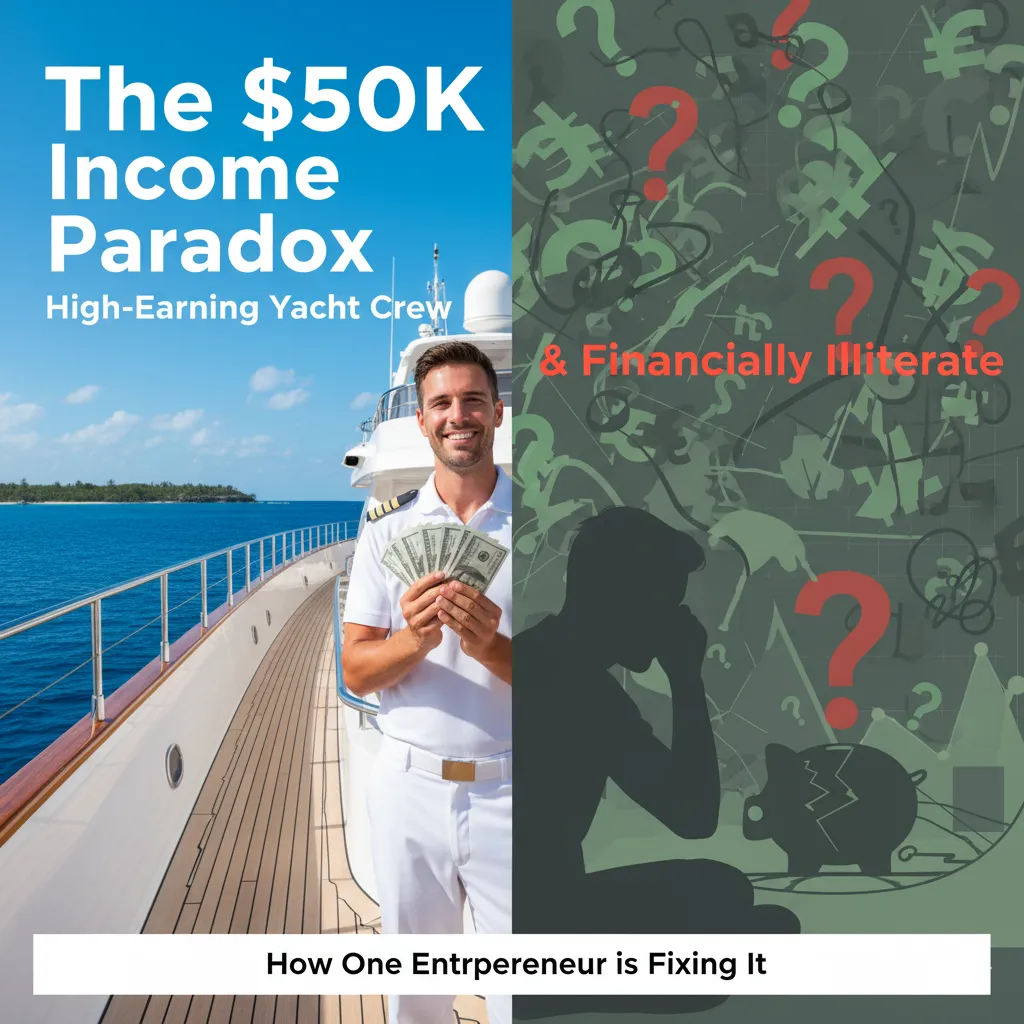
The $50K Income Paradox: Why High-Earning Yacht Crew Are Financially Illiterate (And How One Entrepreneur is Fixing It)
“Be Clear, Be Grateful and Listen”
The $50K Income Paradox: Why High-Earning Yacht Crew Are Financially Adrift
Lessons From a Growing Movement to Fix Yachting’s Financial Literacy Crisis
Part 1 of the Yacht Crew Wealth Series
Every yacht crew member has felt it — that quiet, uncomfortable truth you don’t talk about at the dock.
You make good money… great money compared to most land jobs. You live on multi-million-dollar vessels, work for ultra-wealthy clients, and see wealth up close every day.
But when it comes to your own financial life?
The future feels foggy.
Despite earning $50,000 to $100,000+ a year, most yacht crew are financially under-equipped. No investment plan. No retirement strategy. No idea how taxes actually work. And no one to teach them.
One entrepreneur decided that had to change.

WHY YACHT CREW STRUGGLE FINANCIALLY
Yacht crew don’t struggle because they’re irresponsible.
They struggle because the system around them was never built for them.
The biggest problem?
Financial literacy is practically nonexistent in the yachting industry.
You can run a 45-meter vessel, maintain a power management system, or handle demanding owners without blinking — but most crew have never learned:
How to invest
How taxes actually work
How to build long-term wealth
How to use high income strategically
How to avoid lifestyle creep
Charlminnaar, founder of The Yachting Investor, saw this first-hand.
“There’s a financial literacy gap among yacht crew members. They earn good money, but they don’t know how to make that money work for them.”
What she found wasn’t just a gap.
It was a crisis.
THE WHATSAPP COMMUNITY THAT TURNED INTO A MOVEMENT
What started as a simple WhatsApp group… exploded.
Today, that group has grown to nearly 1,500 active yacht crew, sharing information about:
Investing
Real estate
Taxes
Budgeting
Wealth building
Side hustles
Life after yachting
This wasn’t accidental growth.
It was a clear sign that yacht crew are hungry — starving — for financial guidance tailored to their world.
A world where:
Income is irregular
Tax rules vary by country
Crew don’t get retirement benefits
Banking while traveling is difficult
Financial advisors don’t understand the lifestyle
Traditional financial education never addressed these realities.
So Charlminnaar built something that did.

BUILDING A VETTED FINANCIAL ECOSYSTEM FOR YACHT CREW
Yacht crew don’t need random advice.
They need specialized, vetted, legitimate support.
That’s why Charlminnaar began building a curated catalog of:
Tax advisors who understand international crew
Investment platforms suitable for high-income nomads
Real estate resources specific to transient earners
Financial planners familiar with maritime work
Wealth-building tools built for mobility
This ecosystem solves a major industry problem:
Traditional financial services simply don’t understand yacht crew.
Their structure, their mobility, their tax exposure, their income patterns — none of it fits traditional models.
So she created a system that does.
THE PARTNERSHIP STRATEGY: SMART GROWTH, NOT SOLO GROWTH
Serving the maritime world is complex.
Different sectors have different rules, cultures, and tax realities.
When Scott stepped in with guidance, he offered a critical insight:
“Don’t try to become the expert in every maritime segment. Partner with specialists. Scale through collaboration, not complexity.”
This one shift unlocks massive growth.
Because real scale doesn’t come from trying to be everything.
It comes from building with experts who already are.
FROM DIGITAL CONNECTIONS TO REAL-WORLD COMMUNITY
Online education is powerful — but real relationships are built face-to-face.
Charlminnaar is now planning:
In-person meetups in Fort Lauderdale
Live workshops for yacht crew
Recorded financial webinars
Hybrid events for global access
This digital-to-physical strategy mirrors what top professional communities do:
Build online for scale. Build offline for trust.

SMART LEADER INSIGHTS
Q: Can calmness really be learned, or is it something you're born with?
A: It’s learned through repetition. Composure is a skill, not a personality type. The more you practice staying grounded, the stronger the habit becomes.
Q: How can leaders encourage bold thinking on their teams?
A: Normalize experimentation. Reward initiative. Treat failure as data, not disaster.
Q: What’s the fastest way to improve leadership decision-making?
A: Bias toward action. Perfectionism slows leaders down. Progress compounds.
Q: How important are associations for leadership growth?
A: Essential. Your circle influences your belief system, mindset, and ambition more than any strategy book ever will.
THE “ACCUMULATION PHASE” MINDSET
Many yacht crew are earning the highest income they may ever earn.
The real question is:
What are you doing with it?
Scott shared the perspective of someone deep in wealth-building mode:
Invest early
Invest consistently
Invest with a plan
Protect your family’s future
Let your income create long-term assets
This resonates deeply with crew who know the truth:
The money is great — but the career is short.
The real goal isn’t earning more.
It’s building something that lasts.
LEARNING FROM TIMELESS INVESTMENT PRINCIPLES
Charlminnaar’s own education reinforces her vision.
Her reading list includes:
The Almanac of Naval Ravikant
The Book on Investing Like Warren Buffett
Not hype.
Not speculation.
Not “crypto moonshot” nonsense.
Long-term, proven wealth-building fundamentals.
This signals exactly what yacht crew need:
A platform based on wisdom, not wishful thinking.
THE LIFESTYLE ALIGNMENT FACTOR
Financial advice only works if it fits people’s lives.
Yacht crew aren’t desk workers.
They’re athletes, travelers, adventurers — people who climb mountains, race sails, run marathons, dive reefs, and live globally.
Charlminnaar’s own passions — rugby, rock climbing, endurance sports — help her relate to this identity.
She understands:
Wealth planning must fit the lifestyle, not fight it.
UNIQUE FINANCIAL CHALLENGES YACHT CREW FACE
Most industries have predictable systems.
Yachting doesn’t.
Crew face:
Irregular income
Contracts. Seasons. Tips. Boat changes.
Complex tax rules
Multiple countries. Confusing residency. Maritime exemptions.
No retirement plans
No 401(k). No pension. No employer benefits.
High mobility
Difficult banking. Constant travel.
Cash-heavy culture
Limited documentation. Harder loan approvals.
This is why generic financial advice fails yacht crew completely.
THE SCALABILITY OPPORTUNITY
The model working for yacht crew can work for:
Merchant mariners
Cruise ship staff
Offshore oil workers
Commercial fishing crews
Cargo ship personnel
Millions of people globally share the same financial challenges.
This isn’t just a yacht solution.
It’s a maritime revolution.
SMART CREW INSIGHTS
Q: Why do yacht crew struggle with investing despite high income?
A: Because high earnings don’t automatically create financial literacy. Without education, structure, and mentorship, income gets consumed instead of invested.
Q: What type of investment strategies work best for yacht crew?
A: Simple, long-term strategies—index funds, real estate, automated contributions, and low-risk diversified assets. Consistency matters more than complexity.
Q: How can yacht crew overcome tax confusion?
A: By working with tax specialists who understand maritime income, residency rules, and international work patterns. Generic accountants can cost crew thousands.
Q: Can yacht crew really build long-term wealth?
A: Absolutely. Their income puts them in a better position than most people — if they learn how to convert income into assets systematically.
CONCLUSION
High earnings don’t create wealth.
Financial literacy does.
The truth is simple:
Yacht crew aren’t failing.
The system failed them.
But entrepreneurs like Charlminnaar — supported by advisors like Scott — are building the first real solution:
Education
Community
Vetted services
Real mentorship
Scalable support
This movement is changing the financial future of an industry that desperately needs it.
And it’s only the beginning.


